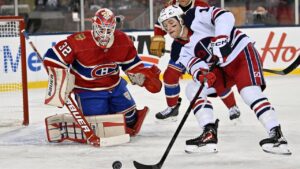
When Tristan Luneau signed a six-year, $43.2 million contract with the Anaheim Ducks, I had the type of small panic that’s uncommon in my line of work: “Oh my god,” I thought, “how could I not know more about a player worth 40 million dollars?”
The NHL is huge, spanning 32 teams with 23-man rosters, and my job is to know everyone encapsulated by those numbers, plus a few more. At least I should be aware of all the fringe guys on each team, and maybe know a tidbit or two about some of these lesser-known players. But for somebody whose name I only sort of recognize to sign a long-term deal at over $7 million per season, it felt like I was about to be exposed as a fraud. How could I miss such a big fish?
I opened my laptop, sent a few texts, and here we are. He’s 22 years old, a hair over league average size, and was supposed to be a big part of Team Canada’s world junior team in 2024 before a viral infection kept him out (that bit I vaguely recalled). He’s a right-shot defenceman who was drafted in the second round, and he’s had two years in the AHL putting up nice point totals -- really nice actually: he was nearly at a point per game two years ago, and had 41 points in 70 games last season.
Still, this contract seemed crazy, until I thought… and then I really thought… and then I thought some more...
...and, wait: this deal IS crazy. I was with the Marlies when we had a 6-foot-4, 21-year-old, right-shot defenceman named Andrew Nielsen who put up nearly that exact stat line as Luneau, and I only mention that to show minor league success is no guarantee of the same in the NHL. Nielsen was a great player there.
In sum, I was this old Simpsons meme:
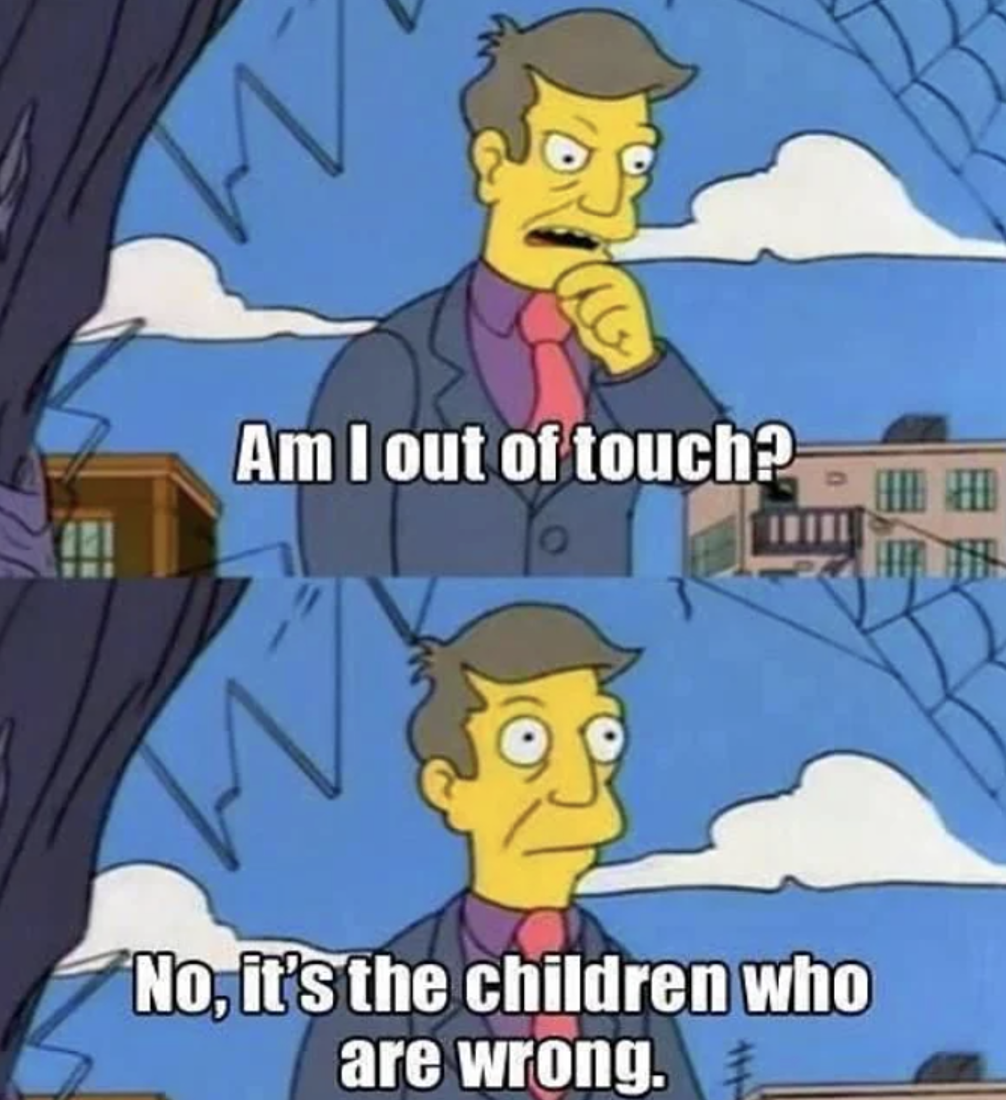
Just replace “children” with “NHL GMs.”
What are the Ducks doing here? What is everyone doing?
The point of betting on someone before they hit isn’t to pay them fairly if they break out, it’s to get out-sized value after taking such a massive risk with your cap hit (and real dollars) early, and with that roster spot for years to come. You’re supposed to be trading young players job security in exchange for dollar savings. You’re not supposed to just offer them job security, hope they hit your lofty projections, and then pay them fairly for those outcomes.
Luneau is indeed supposed to be a very good NHL player, and like Zeev Buium in Vancouver, is forecast to produce points from the back-end at that level. People I’ve talked to like Luneau. But, he obviously hasn’t proven capable of doing that in the NHL yet, because he’s only been granted 14 games (stuck behind a lot of veteran defencemen last year), and racked up two goals and two assists for four points.

Real Kyper and Bourne
Nick Kypreos and Justin Bourne talk all things hockey with some of the biggest names in the game. Watch live every weekday on Sportsnet and Sportsnet+ — or listen live on Sportsnet 590 The FAN — from 4 p.m. to 6 p.m. ET.
Full episode
If Luneau were just getting paid for what he’s expected to do when this contract begins in 2027-28, one assumes that number would be closer $2-3 million, depending on how this season goes. He’s RFA age. Maybe he’ll be awesome this year and that number ends up being four, or somehow five. But regardless, until he proves he’s in the upper echelon of point-producing defencemen, his real value in the next couple seasons is probably less than the number he’s now signed for...and probably by a good bit.
So he has work to do just to earn this contract, but then he has to provide more value later in the deal than the $7.2 million he'll be making, and that’s just to get back to level. For the Ducks to get potential value out of this risk, Luneau has to play like an $11-plus million defenceman for a couple years. And while that’s possible, it’s not a savvy bet -- it’s a flat-out slot-machine level gamble on a player’s ceiling. Consider how far he’d have to surpass that level to offer real savings.
The Ducks also gambled like this to a lesser degree with Pavel Mintyukov, who should be very good too, but what Mintyukov will eventually become is still very much up in the air. (Around the league, similar bets were made on Simon Nemec and Buium.)
I get that coming out of the Leo Carlsson offer sheet the Ducks didn’t want to be left with other teams dictating the terms for their players, but that doesn’t require a commitment of such magnitude. Were I cute and punny, I might suggest it were overcompensation.
More generally though, I think we’re seeing what happens when a strategy of the proactive teams gets adopted by the masses -- they know what it looks like, but they don’t really understand the premise of why the action is being taken. Just like teams acquired “analytics people” in recent years, the late adopters typically didn’t understand why they had hired these types or what it was they were trying to do, they just didn’t want to look archaic. They couldn’t extract value from it.
In this case it seems like teams have noticed the great value Carolina has in the Logan Stankoven and Jackson Blake deals, and took away the lesson “go long early” and missed the ideas about when to do it and why. These two players had already shown they could contribute at the NHL level, and right as they were popping, they got their contracts locked down. But signs that they would pop at the NHL level came first.

32 Thoughts: The Podcast
Hockey fans already know the name, but this is not the blog. From Sportsnet, 32 Thoughts: The Podcast with NHL Insider Elliotte Friedman and Kyle Bukauskas is a weekly deep dive into the biggest news and interviews from the hockey world.
Latest episode
Yes the salary cap has gone up, and should continue to go up considerably. Yes you can buy out the contract of players under 26 for one-third of their value. This part in particular is a popular defence of these contracts, which should tell you a little something about them: “Ah, you can buy it out for a bargain” is a weird contract defence.
I recognize that in five years a lot of these deals will look just fine. Defencemen making what Luneau will only need to be about second-pair guys to be paid fairly in a few years. But outside of the league-leading defencemen, it’s hard to see these recent deals providing much in the way of total value.
I’d also like to add: Good for the players, I don’t blame them one bit for signing these deals, and none of this is criticism of their play or potential. Get that money, man.
But the part I keep getting hung up on in my head, is just … who are they bidding against with these numbers? Did one offer sheet this summer imply that we were going to see an onslaught of 10 more? Luneau’s never spent a month in the NHL, and yet $7.2 million was as low as he would’ve signed for?
Even if that were the case (the ultimate “bet on yourself”), let’s say you know you want to lock him up for real term: how is that six years and not four? Or even three? Five takes him to UFA, but four keeps you in control and allows you to get several years out of him at presumably something more like $4 million per. It’s still a risk, but if – and it’s a big if – he hits as a star, you’ll then be able to lock that player up for a bigger piece of their career. Even going big on the next two years after a four-year deal (if you want to compare how much it would cost over those six seasons) would keep the six-year-total in a similar ballpark, but then you’d have the chance to lock up this “star” for many more years, negotiating with an RFA.
When teams are punished for waiting – a la Carlsson – it’s usually on guys who we’re sure are stars because they’ve shown it. Simon Edvinsson has shown he can play top pair minutes in the NHL, and Detroit waited while trying to play hardball -- which is what you’re not supposed to do -- and have only seen the cost of his contract go through the roof as kids like Luneau sign.
If a player has shown they can do it at the NHL level, go for it. Even if it’s a small sample, but you believe in them and you’ve seen flashes of it, you’re good. Go for it. But if you’re betting on the pedigree that got them to the league, pump the brakes.
NHL GMs reacted to the Carlsson offer sheet and dollar amount by collectively setting their hair on fire and shovelling money at any kid in their organization with potential. Many of them are going to wind up with good value deals out of it, just by the sheer math of prospects and where the cap is going. But they’ve missed the chance to find value, and locked themselves into players we’re not sure about yet.
In a game where we play a lot of probabilities and take some chances, this is the most we’ve seen it happen off the ice. GMs have gone on offence, and they’re just hoping for it to bounce their way. They might want to ask their coaches how they feel about playing “hope” hockey.


 4:15
4:15